

Your oral health has a direct impact on your overall health, so its maintenance is essential. Sometimes, despite your best efforts, you need a tooth extraction. This is when a dentist removes your tooth from its socket in the bone. It can seem scary, but in some cases, it improves your oral health. If you are unsure whether you need one, you should understand the reasons behind tooth extractions, how the process works, and when it becomes necessary.
In this article, we will discuss when a tooth extraction is necessary, how it helps, and what to expect during the procedure. Let us learn why, when, and how tooth extractions can help keep your smile healthy.
What Are the Common Reasons for Tooth Extraction?
There are many reasons for tooth extraction, some of which are more common than others. Let us look at some of the most common ones that a dentist can recommend for tooth extraction.
Tooth Decay or Infection
The main reason for tooth extraction is severe tooth decay or an infection that a root canal cannot treat. Tooth decay is when harmful bacteria break down your tooth, resulting in cavities that can affect the pulp of the tooth. If the infection spreads to the pulp and roots and becomes too advanced, a root canal alone may not be enough.
In such cases, your tooth may need to be removed to prevent the infection from spreading to other parts of the mouth or body. An infection can cause significant pain and swelling. If left untreated, it can lead to more serious health issues, which is why a dentist may recommend extraction as a solution.
Impacted Wisdom Teeth
Wisdom teeth, also known as third molars, are the last set of teeth that are at the back of your mouth. Most people have them, but some lack the space to emerge properly. As a result, wisdom teeth become “impacted,” meaning they remain stuck beneath the gum line. Impacted wisdom teeth come with pain, swelling, and even infection. In such cases, a dentist prefers extraction to avoid more complications.
Crowded Teeth
A dentist also recommends a tooth extraction when there is overcrowding in your mouth. This is especially for people who are preparing for orthodontic treatment, such as braces. If your teeth are too crowded, it becomes harder to straighten them properly. Removal of one or more teeth gives the remaining teeth more space to shift into better positions. This is typically done when you want to achieve a healthier bite or to create more space for braces to work effectively.
Gum Disease
Gum disease, also known as periodontal disease, is an infection of the gums and tissues surrounding your teeth. In its early stages, good oral hygiene and professional cleanings can treat gum disease. But if it progresses and causes the gums to recede greatly, it can damage your teeth’s supporting structures. In some cases, the tooth loosens and needs to be extracted to prevent further infection.
Trauma or Injury
If you suffer from an accident or injury that severely damages a tooth, it may be difficult to repair. For example, a cracked or broken tooth that is beyond repair only needs extraction. In such cases, removing the damaged tooth will not only reduce pain but also help prevent damage to neighboring teeth.
Failed Root Canal Treatment
A root canal is a procedure that saves a damaged tooth by removing the infected pulp. But sometimes a root canal does not fully remove the infection, or the tooth does not heal properly afterthe treatment. If a root canal fails, the infection recurs, leading to more pain and increased health risks. In these cases, the dentist recommends removing the tooth entirely to resolve the issue.
What Happens During a Tooth Extraction?
If your dentist recommends a tooth extraction, you will definitely think about what will happen to you. We provide everything you need to know about what to expect during the procedure. The process is performed by an oral surgeon or a dentist. It is relatively simple, as given below:
Before the Extraction
Before the tooth extraction, the dentist will take an X-ray of your tooth to better understand its position. In this way, the dentist will decide the best method for extraction. After creating a plan, they will discuss the procedure with you and explain how they will keep you comfortable.
You will receive a local anesthetic, which numbs the area around your tooth so that you do not feel any pain during the procedure. When you feel nervous, you can ask your dentist about sedation options to help you relax.
During the Extraction
If the anesthetic has taken effect, the dentist will gently loosen your tooth from the socket with special tools. In some cases, if the tooth is impacted, the dentist makes a small incision in the gum to access the tooth. It will then be carefully removed. If you need multiple teeth extracted, the dentist will do them one at a time.
After the Extraction
After the removal of the tooth, the dentist will ask you to bite down on a piece of gauze to have a control bleeding. They will also provide you with aftercare instructions to help you heal perfectly. You must follow these instructions to ensure proper recovery and avoid the associated complexities.
You may feel some swelling and discomfort after the procedure, but all these symptoms are usually temporary, and you can manage them with pain relievers. Your dentist will also recommend ice packs and special mouth rinses to help you recover more quickly.
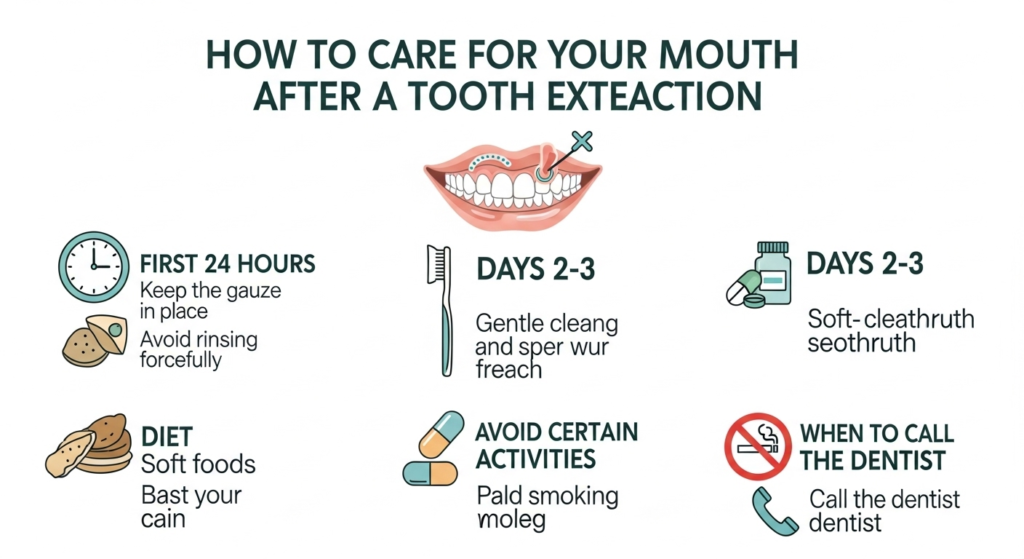
How to Care for Your Mouth After a Tooth Extraction?
Tooth extraction is not the last step. There is a lot to do after it, that is, nothing but proper care after extraction for speedy recovery. Healing time is different for everyone. The following are a few general tips to speed up the process:
- Follow Post-Op Instructions: Your dentist will give you detailed instructions on how you can care for your mouth after the completion of the procedure. Be sure to follow them carefully to avoid other dental issues.
- Rest and Avoid Strenuous Activities: Rest is a must after any dental procedure. Don’t do heavy lifting or exercise for a few days after your tooth extraction.
- Eat Soft Foods: You should eat soft foods that do not irritate the extraction site. Also, stay away from hot foods and drinks for a day or two, as they can cause discomfort.
- Use Ice Packs: Ice packs are the best for reducing swelling and pain. You can apply them to the outside of your face near the extraction site.
- Keep the Area Clean: After the first 24 hours, gently rinse your mouth with warm salt water to help keep the area clean and promote proper healing.
When to Seek Medical Attention
If you experience continuous or severe pain, prolonged bleeding, or signs of infection such as fever, contact your dentist right away. These are some signs of complications that need immediate attention and treatment.
Why Choose Missouri Gardens Dental?
Patients often choose Missouri Gardens Dental because the practice offers a patient-first approach to comprehensive care. Key factors for our selection are the available services, including general, cosmetic, family, and emergency dentistry for all ages.
Our specific treatment options, including crowns, dental implants, veneers, Invisalign, bridges, and full-mouth reconstructions, ensure that all patients’ needs are met in one location. These options, plus the use of advanced dental technology, attract those who need effective treatment for both immediate issues and long-term oral health.
Final Thoughts!
Everyone feels tooth extraction to be something so uneasy, but in many cases, it is necessary to protect your overall oral health. Whether due to severe decay, gum disease, or an injury, your dentist recommends extracting a tooth. If you understand when a tooth extraction is necessary and how to care for yourself afterward, you can enjoy a smooth, speedy recovery. In case of any dental issue, do not wait too long to get checked out by a professional.
Schedule a consultation with your dentist today to discuss your oral health needs and whether a tooth extraction is the right solution for you.